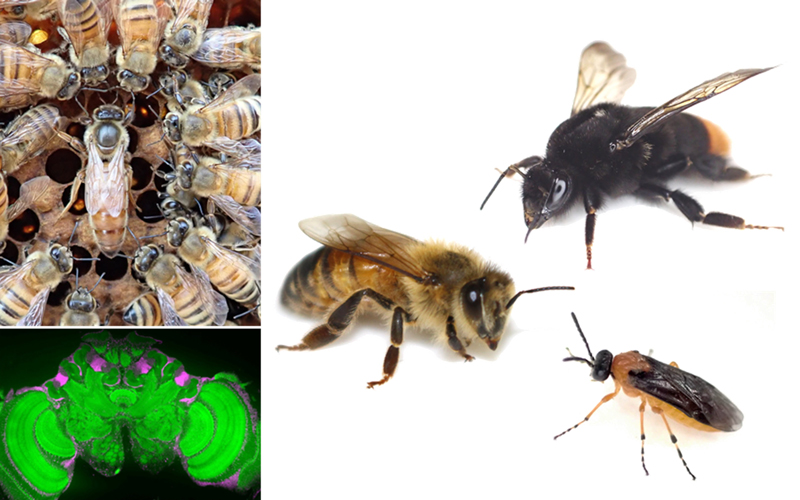
Insects have adapted to almost every environment on Earth, acquiring a wide array of adaptive behaviors. In particular, the order Hymenoptera has evolved to encompass species with various behaviors along with phylogenetic divergence—including phytophagous, parasitic, and nesting lifestyles, as well as varying levels of sociality—thereby serving as a valuable lineage for investigating the neural basis of behavioral evolution. Mainly using the eusocial European honey bee, our group aims to clarify the molecular and neural basis of social behavior and its evolution. To achieve this, we analyze the function of genes and brain regions related to honey bee social behavior by expanding genetic manipulation tools and developing new behavioral experimental systems. We also explore the brain basis related to sociality by comparing gene expression profiles in brain regions and their constituent cells with those of closely related species that show different behavioral traits.
Research Projects
-
• Expansion of genetic manipulation methods in the honey bee
-
• Behavioral assay systems for inter-individual interactions in the honey bee
-
• Evolutionary developmental analysis of mushroom body constituent cells in hymenopteran insects
-
• Comparative analysis of mushroom body constituent cells between bee species with different levels of sociality
Selected Publications
Kamata, S., Kubo, T., and Kohno, H. (2025). Analysis of molecular and cellular bases of honey bee mushroom body development. Sci. Rep. 15, 21462.
Kohno, H.*, Kamata, S., and Kubo, T. (2023). Analysis of antennal responses to motion stimuli in the honey bee by automated tracking using DeepLabCut. J. Insect Behav. 36, 332–346. *corresponding author
Kuwabara, T., Kohno, H.*, Hatakeyama, M., and Kubo, T.* (2023). Evolutionary dynamics of mushroom body Kenyon cell types in hymenopteran brains from multifunctional type to functionally specialized types. Sci. Adv. 9, eadd4201. *co-corresponding authors
Kohno, H., and Kubo, T. (2018). mKast is dispensable for normal development and sexual maturation of the male European honeybee. Sci. Rep. 8, 11877.
Oya, S., Kohno, H., Kainoh, Y., Ono, M., and Kubo, T. (2017). Increased complexity of mushroom body Kenyon cell subtypes in the brain is associated with behavioral evolution in hymenopteran insects. Sci. Rep. 7, 13785.
Kohno, H., Suenami, S., Takeuchi, H., Sasaki, T., and Kubo, T. (2016). Production of knockout mutants by CRISPR/Cas9 in the European honeybee, Apis mellifera L. Zool. Sci. 33, 505-512.