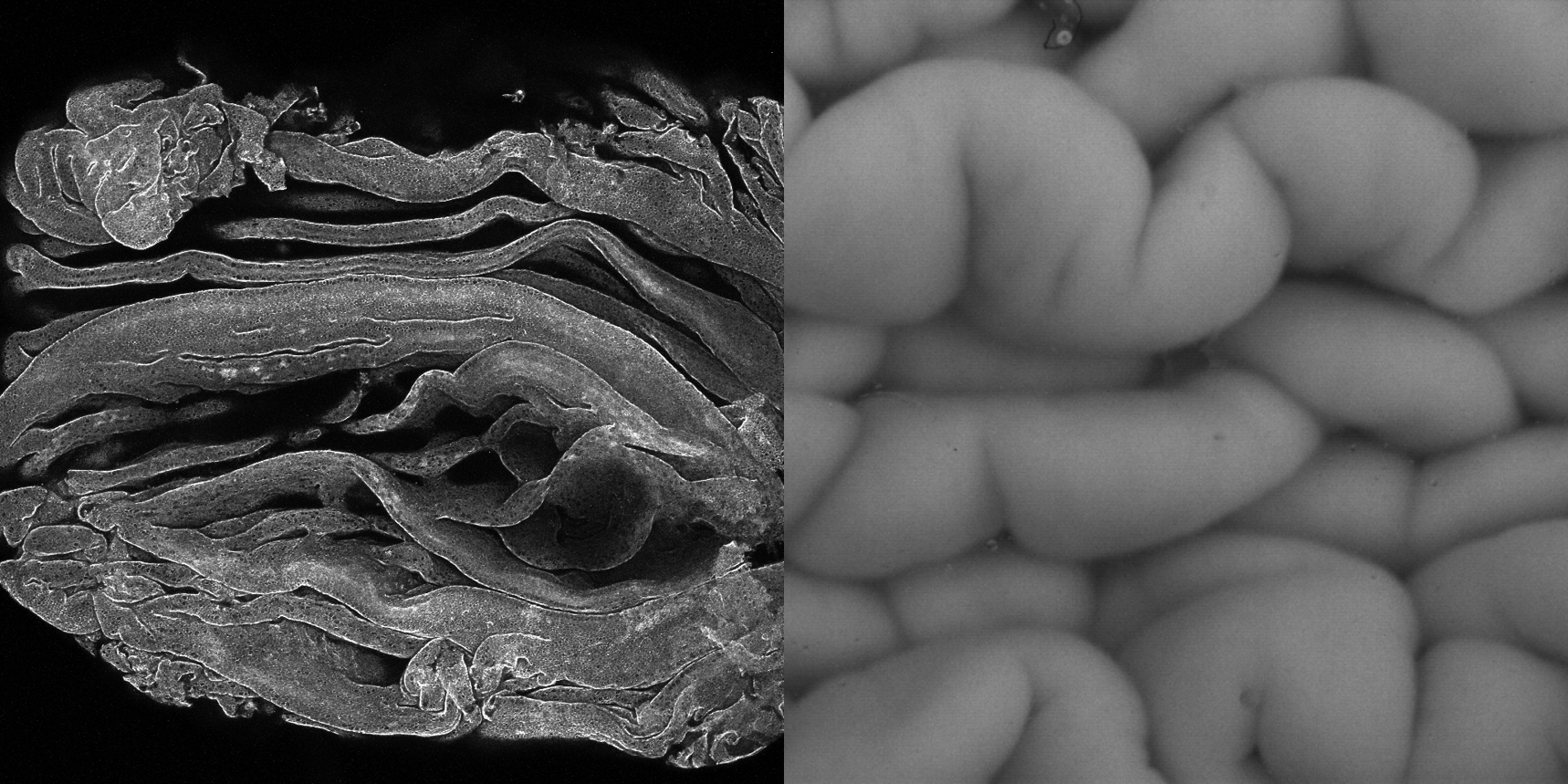
After ovulation, an egg travels through the oviduct (Fallopian tube) toward the uterus (womb). This journey is essential for reproduction: fertilization normally occurs in the oviduct, and the resulting zygote continues developing as it moves toward the uterus.
The inner surface of the oviduct is covered with multiciliated cells. Each of these cells carries approximately 200 motile cilia, whose coordinated beating along the ovary-to-uterus axis generates a force that transports ova toward the uterus. The oviduct lining also forms prominent folds that run along the ovary-to-uterus axis. Because these longitudinal folds are found in the oviducts of many vertebrates, including mammals, birds, and amphibians, they have long been thought to facilitate transport of ova.
figure. Longitudinal epithelial folds in mouse (left) and chicken (right) oviducts
Until now, however, it has been difficult to determine whether the straight alignment of these folds is actually required for transport. Genetic alterations that disturb the folds often also disrupt ciliary orientation or the overall structure of the oviduct, making it impossible to isolate the contribution of the folds themselves.
A research team led by Dr. Masaki Arata and Professor Toshihiko Fujimori at the National Institute for Basic Biology in Japan has now shown that oocytes can reach the uterus even when the longitudinal alignment of the oviduct folds is severely disrupted. The findings appear in the
Proceedings of the National Academy of Sciences of the United States of America.
The researchers studied mice with strongly reduced levels of VANGL1, a protein involved in planar cell polarity—the coordinated orientation of cells and cellular structures within the plane of a tissue. In normal mouse oviducts, the epithelial folds extend relatively straight from the ovary toward the uterus. In the mutant mice, by contrast, the folds were irregularly oriented and extensively branched.
Despite this disruption, high-speed imaging and quantitative analysis showed that ciliary beating remained largely directed along the ovary-to-uterus axis. The mutant females were also able to produce offspring, indicating that oocytes or early embryos could successfully travel through the oviduct and reach the uterus.
“We initially expected the mutant to show defects in both ciliary beating orientation and fold architecture, as seen in another planar cell polarity mutant,” said Dr. Arata. “Instead, the cilia largely retained their orientation toward the uterus, while the fold architecture was severely disrupted. This gave us a valuable opportunity to distinguish the role of the folds from the directional force generated by ciliary beating.”
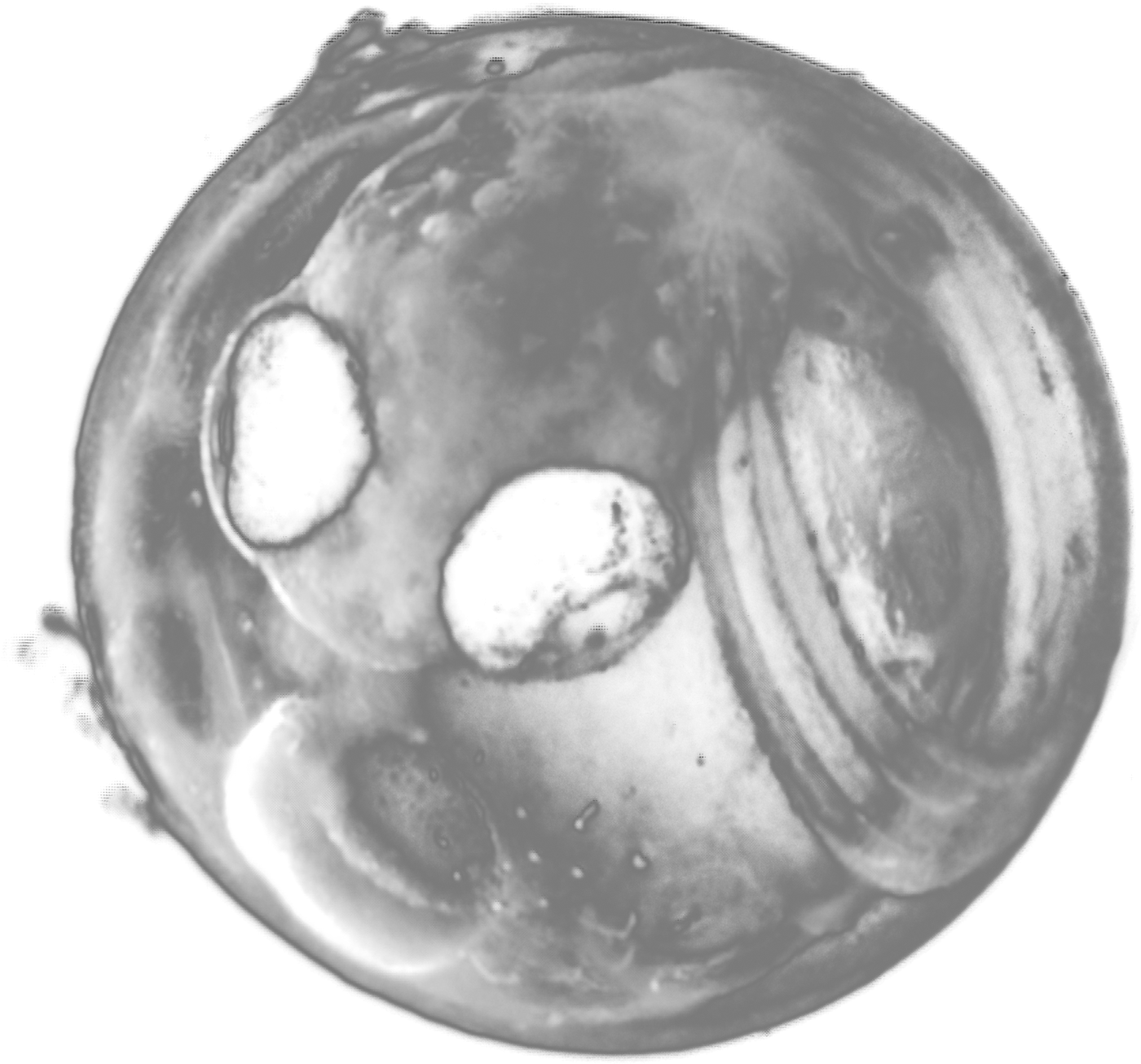
To examine transport more directly, the team placed fluorescent beads on the exposed inner surface of the oviduct and recorded their movements. In both normal and mutant oviducts, the beads moved predominantly toward the uterus. However, in the mutants, their movement was slower and their trajectories were less straight. Beads were also occasionally caught near branched regions of the folds. These observations suggest that straight longitudinal folds are not strictly necessary for uterine-directed transport, but may make transport faster, more stable, or more efficient.
“Tracking the fluorescent beads allowed us to detect differences that were not apparent from fertility alone,” said Dr. Usami. “Although transport toward the uterus was preserved, the slower and less direct movement revealed a reduction in transport efficiency.”
“Our findings suggest that the longitudinal folds are not an indispensable conveyor belt for oocyte transport,” added Professor Fujimori. “Rather, they may provide a structural environment that improves the efficiency and reliability of transport.”
These findings provide important insights into how tissue architecture and ciliary orientation are established in the oviduct and how they work together to support reliable transport. Beyond the oviduct, the findings may also contribute to a broader understanding of organs that use motile cilia to transport materials, including the respiratory tract and brain ventricles.
[Paper Information]
Title: Successful oocyte transport through the oviduct does not depend on the longitudinal alignment of oviduct epithelial folds
Authors: Fumiko Matsukawa Usami, Masaki Arata, Kagayaki Kato, Dongbo Shi, Sanae Oka, Yingzi Yang, and Toshihiko Fujimori
Journal:
Proceedings of the National Academy of Sciences of the United States of America
Publication date: August 4, 2026
Embargo: August 3, 2026, at 3:00 p.m. U.S. Eastern Time
DOI:
https://doi.org/10.1073/pnas.2605383123
[EurekAlert!]
https://www.eurekalert.org/news-releases/1139090