

Vectors for medaka transgenesis/メダカのトランスジェネシス用ベクター
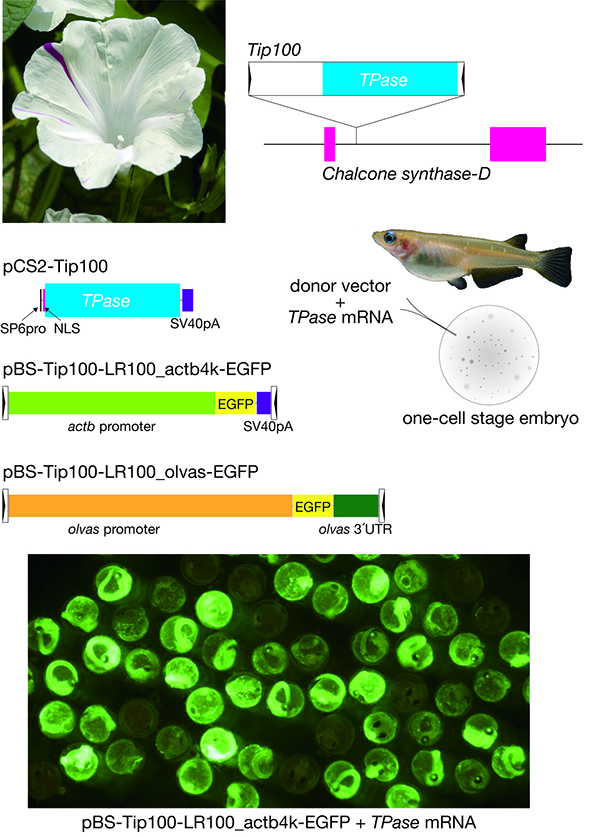
The common morning glory (Ipomoea purpurea) transposon Tip100 is a member of the hAT (hobo–Ac–Tam3) superfamily of DNA transposons. It was originally isolated from the a-flaked locus, which confers variegated flowers (Habu et al., 1998). Its autonomous nature, including the ability to encode a functional transposase, was demonstrated by Ishikawa et al. (2002).
A highly efficient medaka transgenesis system using Tip100 was subsequently developed through collaboration between Dr. Satoshi Ansai’s group at Okayama University and our laboratory (Tanaka et al., 2025). This method involves co-injection of a donor plasmid containing a marker gene cassette flanked by the Tip100 terminal sequences together with in vitro-transcribed transposase mRNA into one-cell stage embryos. Notably, the terminal sequences can be shortened to 100 bp on each side without compromising transposition activity, and the germline transmission rate reaches 62.7%, which is exceptionally high among teleosts. NBRP Morning Glory provides the three plasmids required for Tip100-mediated transgenesis:
pCS2-Tip100
A plasmid for in vitro transcription of mRNA encoding the Tip100 transposase (808 amino acids) under the control of the SP6 promoter.
pBS-Tip100-LR100-actb4k-EGFP
A donor vector carrying a ubiquitously expressed EGFP reporter driven by the 4-kb medaka β-actin (actb) promoter. It contains the shortened terminal sequences of Tip100 (100 bp on each end) and is suitable for evaluating somatic integration efficiency.
pBS-Tip100-LR100-olvas-EGFP
A donor vector carrying a germ cell-specific reporter driven by the medaka olvas promoter and olvas 3′ UTR. It enables sensitive detection of GFP signals in germ cells of G0 embryos and is useful for assessing germline integration and establishing stable transgenic (F1) lines. This vector also utilizes the shortened Tip100 terminal sequences (100 bp on each end).
Distribution requires completion of a Material Transfer Agreement (MTA) and payment of a distribution fee (3,300 JPY + 500 JPY per plasmid + actual shipping costs [+ card handling charge]). For additional details, please refer to the distribution guidelines .
マルバアサガオ(Ipomoea purpurea)のTip100は、hAT(hobo–Ac–Tam3)スーパーファミリーに属するDNA型トランスポゾンです。マルバアサガオの花にキメラ斑(斑入り)を形成する条斑(a-flaked)遺伝子座から単離されました(Habu et al., 1998)。また、Tip100が転移酵素(transposase)を自らコードする自律性トランスポゾンであることは、石川らによって示されています(Ishikawa et al., 2002)。
岡山大学の安齋聡先生のグループと当研究室は、Tip100を利用したメダカの高効率トランスジェネシスに成功しました(Tanaka et al., 2025)。このトランスジェネシスは、Tip100の両末端配列で挟んだマーカー遺伝子カセットを含むドナーベクターと、Tip100 の転移酵素遺伝子のmRNAを1細胞期胚に同時にインジェクションすることで行います。両末端配列を100 bpずつに短縮しても高い転移活性が維持され、生殖系列導入効率が62.7%と非常に高い点が大きな利点です。NBRPアサガオでは、このトランスジェネシスに必要な3種類のプラスミドベクターを提供しています。ベクターの提供には、MTAの締結および提供手数料(3,300円 + 500円 × プラスミド数 + 送料実費)の納付が必要です。詳しくは分譲手続きのページをご参照ください。
pCS2-Tip100
転移酵素(808 aa)をコードするmRNAを、SP6プロモーター下でin vitro転写するためのベクターです。
メダカβ-actin(actb)4 kbプロモーターにより胚全体でGFPを発現するユビキタス型レポーターをもつドナーベクターです。短い末端配列(100 bp × 2)を利用しており、体細胞への導入効率の評価に適しています。
pBS-Tip100-LR100-olvas-EGFP
生殖細胞特異的に発現するolvasプロモーターとolvas 3’UTRを備えたレポーターをもつドナーベクターです。G0個体の生殖細胞におけるGFPシグナルを高感度に検出でき、生殖系列導入の判定および安定なトランスジェニックライン(F1)樹立に有用です。こちらも短い末端配列(100 bp × 2)を利用しています。
Download/ダウンロード
- pCS2-Tip100.dna
- pCS2-Tip100.fasta
- pBS-Tip100-LR100_actb4k-EGFP.dna
- pBS-Tip100-LR100_actb4k-EGFP.fasta
- pBS-Tip100-LR100_olvas-EGFP.dna
- pBS-Tip100-LR100_olvas-EGFP.fasta
- MTA (English)
- MTA (日本語)
Files in the .dna format can be opened with the free software SnapGene Viewer.
.dna形式のファイルは、フリーソフトウェアのSnapGene Viewerで開くことができます。
References/参考文献
- Y. Habu, Y. Hisatomi and S. Iida: Molecular characterization of the mutable flaked allele for flower variegation in the common morning glory. Plant J. 16, 371–376 (1998) doi>
- N. Ishikawa, Y. Johzuka-Hisatomi, K. Sugita, H. Ebinuma and S. Iida: The transposon Tip100 from the common morning glory is an autonomous element that can transpose in tobacco plants. Mol. Genet. Genomics 266, 732–739 (2002) doi>
- Y. Tanaka, T. Seki, A. Hoshino and S. Ansai: Highly efficient transgenesis mediated by Tip100 transposon system in medaka. Transgenic Res. 40, 46 (2025) doi>
Contact/連絡先
Hoshino Atsushi
National Institute for Basic Biology, Nishigonaka 38, Myodaiji, Okazaki, Aichi, Japan, 444-8585
Email: hoshino☆nibb.ac.jp (Please replace ☆ with @)
Phone: +81-564-55-7534
〒444-8585 愛知県岡崎市明大寺町字西郷中38 基礎生物学研究所 星野敦
hoshino☆nibb.ac.jp(☆を、@に置き換えて下さい)
0564-55-7534